Wednesday, 22 June 2016

おもひでぽろぽろ

a film by Isao Takahata

One evening, when we were walking home from some live music event which did not impress Timur much, he asked me what is my favourite Studio Ghibli film. A difficult choice to make! I like most of the movies directed by Miyazaki, especially Nausicaä of the Valley of the Wind and Howl’s Moving Castle. The thing with Miyazaki’s films, though, is that they are more or less the same style. Which you cannot say about work by Takahata. I said that of his films, my favourite is Only Yesterday, and Timur noted that he doesn’t remember much of it. And so, last Sunday evening, we sat down to watch it.

Yes, now I can confirm it: it is my favourite. The scenes with ten-year-old Taeko set in 1966 (50 years ago! Only yesterday, indeed...) are among the most touching and funny in all of Ghibli films I’ve seen.

Interestingly, or maybe not, Only Yesterday was not released in the US until this year. I am pretty sure it is because the English dub was not available. In any case, I encourage you to watch it in Japanese.

Tuesday, 21 June 2016

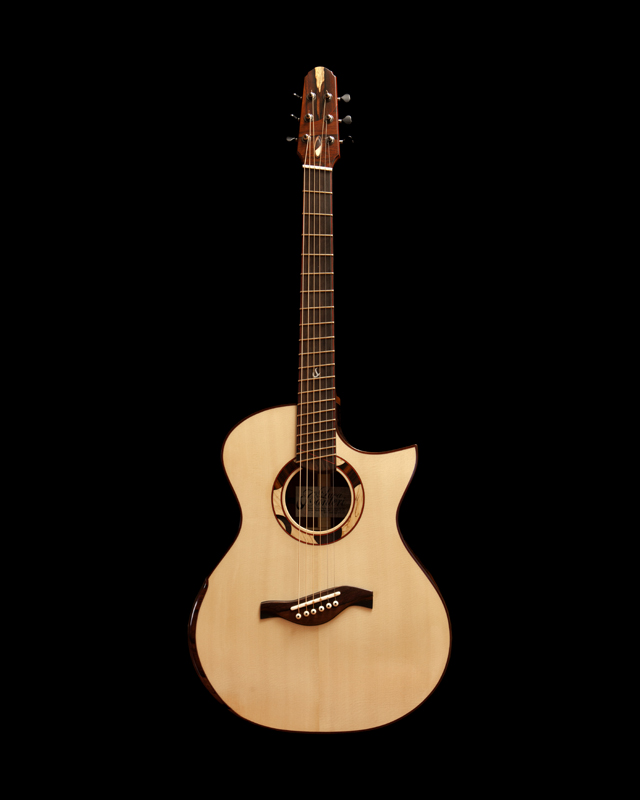
LC Grand Concert Multiscale, Florentine Cutaway

by Luca Canteri

We went to Fuerteventura for a weekend and had a chance to see, try and photograph Luca’s latest creation. In spite of similar name, its appearance is quite different from Grand Concert Cutaway (reviewed almost two years ago). The cutaway is deeper, headstock is pointier, armrest is more pronounced; the overall feel is of a more slender, more modern instrument. I couldn’t compare them side by side but I think this one has sweeter, softer sound than Grand Concert Cutaway. (Hmm. I spy a nomenclature problem here. “Non-Florentine Cutaway” just does not feel right.) And I really liked “the thin red line” formally known as purfling which sometimes abandons the edges and wanders across the neck, the headstock and so on.

Timur also had a go and found it “very nice” even though he, like me, still prefers the classical guitar.

I have to mention that this instrument was not made to order, which means it’s still available and could be yours! Contact Luca for details.

Model specification

  • Top: Italian Spruce
  • Back and sides: Madagascar rosewood
  • Fingerboard: Indian Ebony
  • Bridge: Madagascar rosewood/ebony
  • Neck: mahogany
  • Nut, saddle and pins: bone
  • Rosette: maple and Madagascar rosewood
  • Purfling: dyed maple
  • Tuning machines: Gotoh 510
  • Multiscale: 25″—26″
  • Nut: 45 mm
  • String spacing bridge: 57 mm
  • Upper bout: 30 cm
  • Waist: 24 cm
  • Lower bout: 39 cm
  • Max depth: 11 cm
  • Body length: 49 cm
  • Overall length: 110 cm
  • Bevelled armrest

More photos of acoustic guitar @ Shutterstock.

Friday, 10 June 2016

Jonathan Strange & Mr Norrell

by Susanna Clarke
Magic is not ended in England. I myself am quite a tolerable practical magician.
Gilbert Norrell

I don’t remember when it was the last time I found reading such a thick book so satisfying. Sure, it is long, at 782 pages and 185 footnotes, but not a bit tedious. The only reason it took me about four months was that I read it strictly on weekends, somewhere between going to bed and falling asleep. What I don’t understand though, why it took me more than ten years to start reading it. Ms. Clarke’s first (and so far the only) novel is a great story beautifully told, inventive, tasteful, with just right balance of general scariness and deadpan English humour. I didn’t care much for its protagonists, who, in spite of being “practical magicians”, are rather boring. On the other hand, I grew rather fond of the main villain, the nameless “gentleman with thistle-down hair”: vain and murderous but also generous and, well, charming. It’s a shame he is getting his comeuppance in the end. Or is he?

If you still need any proof that magic has not ended in England, or at least in Yorkshire, read this book.

“Spain is, as your Royal Highness knows, one of the most uncivilized places in the world, with scarcely any thoroughfare superior to a goat track from one end of the country to the other. But thanks to Mr Strange my men had good English roads to take them wherever they were needed and if there was a mountain or a forest or a city in our way, why! Mr Strange simply moved it somewhere else.”

The Duke of York remarked that King Ferdinand of Spain had sent a letter to the Prince Regent complaining that many parts of his kingdom had been rendered entirely unrecognizable by the English magician and demanding that Mr Strange return and restore the country to its original form.

“Oh,” said the Duke of Wellington, not much interested, “they are still complaining about that, are they?”

Friday, 3 June 2016

Genesis

by Sebastião Salgado

One day, a small army of huge rusty iron frames appeared in the park of San Telmo. They host Genesis, a project of Sebastião Salgado — another world-famous photographer I never heard about before. Now that I did, and had a chance to investigate, I am telling you: totally worth seeing, especially when it’s free. So if you are in Las Palmas, don’t miss. Until 21 June.

Saturday, 21 May 2016

Pa’ki pa’ka

by Robert “Robi” Svärd
Dejame sentir la dulce maravilla que tienen tus labios
Dejame decirte morena mia cuanto te amo
Que quiero entregarte lo mas profundo de un sentimiento
Y que tu cuerpo vibre, que vibre con un “te quiero”

Every time I think I heard it all, Songlines proves me wrong. What could one possibly add to what Paco de Lucía has done to flamenco guitar? “Robi” Svärd shows that yes, one can add something else. And that “something else” is not being his “Nordic touch” or (enter here any other cliché pointing to Robi’s origin). At no point his could-have-been-frightening virtuosity stands in the way of his singable, danceable and, well, simply jolly good music. Not exactly what I call “easy listening” but for me the only difficulty was to choose the favourite song! Anyway, here are my top three (for now): Dulce maravilla, with simple but efficient harmonics-driven intro/bridge; bulerías El aire de mi corazón; and a very tasty title track. Enjoy!

Pa’ki pa’ka

  1. Pa’ki pa’ka (rumba)
  2. El aire de mi corazón (bulerías)
  3. Dulce maravilla (alegrías)
  4. La chispa (bulerías)
  5. Caminando (tangos)
  6. Barokería
  7. Lágrimas secas (soleá por bulerías)
  8. Habana a Suécia (guajiras)
  9. Paseo de los tristes (granaina)
    Robert “Robi” Svärd — guitars
    Miguel “El Cheyenne” — percussion (1—8)
    Nani Conde — bass (1, 2, 5)
    Alfredo Tejada — vocals (2, 3, 5, 7)
    Ahmad Al Khatib — oud/cello (2, 3)
    Ann Sehlstedt “La Pantera” — dance (8)

    All tracks composed by Robert Svärd except track 7 (public domain, arranged by Robert Svärd)
    All lyrics by Alfredo Tejada
    Produced by Robert Svärd
    Recorded, mixed and mastered at FJR Estudios de grabación, Granada, May — July 2015 by Robert Svärd and Fernando Romero
    Cover by Andreas Borg

Saturday, 14 May 2016

Fahrenheit 451

by Ray Bradbury

It was thanks to this book which I read in 1970s as 451 градус по Фаренгейту that I remembered, for the first time, any data in this absurd scale — only to learn, already after Bradbury’s death, that paper does not auto-ignite at this particular temperature. Gary Dexter goes as far as suggesting to replace the famous epigraph

‘Fahrenheit 451: The temperature at which book paper catches fire, and burns’

with

‘Fahrenheit 843: The approximate temperature at which rayon fiber untreated with N-methyl-dimethyl-phosphonopropionamide catches fire, and burns’.

Try telling that to Bradbury fans.

Doesn’t matter. When read in Russian, the book was as scary as it was fascinating. Reading it in English, I found it much less so. Could it be because we live in times when people do not read books anymore anyway? Not just the new generation, but especially the new generation, if my students are anything to go by — my, sometimes I sound awfully old. Bradbury’s future has arrived, and it doesn’t look good, but we are getting used to it.

Sunday, 1 May 2016

La Sandunga

by Lila Downs

I discovered Lila Downs in 2004, thanks to Songlines. One of the first issues that I read featured Beginner’s Guide to Lila Downs. Back then, her discography was rather short. Three (of five available) albums were listed as “best”, the new one (Una Sangre) was to be reviewed in the following issue, and La Sandunga, by some reason, was referred to as “best avoided”. And so this snippet of information stayed with me. Now, after avoiding it all these years, I finally bought it, more for completeness’ sake rather than anything else. But what a discovery!

Recorded almost 20 years ago, La Sandunga, far from being just a taste of things to come, is a beautiful piece of work in its own right. Lila’s music is always a fusion, but this one is probably the least “fused” of all her albums. No cumbia, blues or klezmer here. My favourite songs are the two boleros by Álvaro Carrillo, Un poco más and Sabor a mí. The versions of La Llorona and Yunu Yucu Ninu are rather different from you can hear on her later albums. The bonus tracks on this CD are also worth listening to; even Bésame mucho — which you’d think must be, of all Mexican songs, best avoided indeed — sounds fresh. Please give it a listen. You won’t be disappointed.