Bergman’s last cinematic work, starring Ingrid Bergman (no relation) in her final cinema performance, alongside Liv Ullmann. Intense, at times uncomfortable, at times depressing, but not without comic elements courtesy of Ingrid’s vain character, Charlotte.
Showing posts with label Sweden. Show all posts
Showing posts with label Sweden. Show all posts
Sunday, 29 December 2024

Monday, 2 December 2024
Scener ur ett äktenskap
a film by Ingmar Bergman

I had a dilemma: either to rush after work to watch almost three hours of Scenes from a Marriage, with a distinct possibility to fall asleep, or to give it a pass and just have a proper nap. As you may have guessed, my craving for cinema won.
This 1974 film is a theatrical release of a 1973 miniseries of the same name. If the first chapter/episode has a rather extended cast, by Bergman standards anyway, in the last four chapters “only” the protagonists, portrayed by Liv Ullmann and Erland Josephson, remain. It’s long but never boring, and even has a kind of wabey-sabey happy ending: Marianne and Johan evolve from meh spouses to pretty good lovers.
Sunday, 10 November 2024
Viskningar och rop
a film by Ingmar Bergman
How come I never watched Cries and Whispers before? This almost unbearably stylish film centers on four women, gorgeously portrayed by Harriet Andersson, Kari Sylwan, Ingrid Thulin and, of course, Liv Ullmann. On the contary, the men, even David (the great Erland Josephson), are entirely disposable.
Wednesday, 26 January 2022
Arica
a film by Lars Edman and
William Johansson
Everybody known how green Sweden is. Year after year, it is ranked one of the greenest — if not the greenest — countries out there. Of course, depending on the method the greenness is calculated, but still. Very green. For example, it would be unthinkable for a reputable Swedish company to dump their toxic waste “negative value material” some 250 metres from the residential area. Unthinkable.
Another matter is to send it as far as possible, say to South America, and hope that everybody forgets about that. Completely different story.
And this is exactly what happened in the 1980s. The Swedish mining giant Boliden AB, “a metals company with focus on sustainable development”, has shipped about 20,000 tons of smelter sludge containing high concentrations of arsenic, mercury, cadmium and lead, to Arica in northern Chile. The sobering Swedish documentary, the follow-ip to Toxic Playground (2010), makes sure that the story and Arica victims are not forgotten.
So, Boliden. The company I never heard about before, even though I should have. My first association upon watching the film was the fictional Cryolite Corporation from Smilla’s Sense of Snow. To quote one of the characters of the novel,
no one has ever had reason to complain about the corporation’s generosity or openness. And whatever complaints there were have been rectified.
In the spirit of openness, no doubt, Boliden published their version of events, in the “Sustainability” section, which includes a press-release titled “One-sided and misleading film about Boliden’s exports to Chile” as well as “the entire correspondence” between Boliden and United Nations Human Rights Committee, viz. a UNHR letter and Boliden response; two letters in total.
Closer home, Boliden-owned Los Frailes mine, near Aznalcóllar, was the site of Doñana disaster, the worst environmental accident in Spain. 24 years later, Boliden are not in a hurry to pay either, probably expecting that eventually a friendly court will find the claims “time barred”, as it happened in case of Arica.
The screening of the first Documental del Mes this year, in Gran Canaria, Fuerteventura, Tenerife and La Palma, was organised by Filmoteca Canaria.
Monday, 24 December 2018
The Girl with the Dragon Tattoo
by Stieg Larsson

One evening in February 2003, Larsson’s character Mikael Blomkvist
went to the cinema to see <the 2001 film> The Lord of the Rings, which he had never before had time to see. He thought that orcs, unlike human beings, were simple and uncomplicated creatures.
One day in November 2018 I picked up a paperback with rather horrid cover design which had been gathering dust in the teacher’s room. As it happened, I also had never before had time to read this book. The English translation of the international bestseller was published in 2008.
I don’t read Swedish so can’t really offer my opinion on “needless prettification” [1] but I also was not impressed by this particular translation. Nor am I into crime novels. Even so, I was gripped. I spent several nights reading into early hours and now, surprise surprise, I want more.
(Meanwhile, the book is back to its former place, waiting for the next reader.)
Ah, Sweden. Beautiful country, it is. Each part of the novel is preceded by an epigraph. Here they are all:
- Eighteen percent of the women in Sweden have at one time been threatened by a man.
- Forty-six percent of the women in Sweden have been subjected to violence by a man.
- Thirteen percent of the women in Sweden have been subjected to aggravated sexual assault outside a sexual relationship.
- Ninety-two percent of women in Sweden who have been subjected to sexual assault have not reported the incident to the police.
No source of these data is quoted, but the (still depressing) statistics is available elsewhere [2].
Larsson’s wish notwithstanding, the English title makes more sense than Swedish Män som hatar kvinnor, “Men Who Hate Women”, as Lisbeth Salander, “a grown-up Pippi Longstocking”, is a (super)heroine par excellence.
Also, as I just realised, it is an almost perfect Christmas story.
__________________________________________________- According to Wikipedia,
Both Larsson’s longtime partner Eva Gabrielsson and English translator Steven T. Murray have said that Christopher MacLehose (who works for British publisher Quercus) “needlessly prettified” the English translation; as such, Murray requested he be credited under the pseudonym “Reg Keeland”. The English release also changed the title, even though Larsson specifically refused to allow the Swedish publisher to do so, and the size of Salander’s dragon tattoo; from a large piece covering her entire back, to a small shoulder tattoo.
- The 2014 EU-wide survey shows that famously egalitarian Nordic countries also lead Europe, percent-wise, in terms of physical, sexual and psychological violence against women. This contrasts with self-perception of the frequency of said violence: for instance, only 9% of women in Finland view the gender violence as “very common”, compared to Spain’s 31% and EU-28 average 27%, while 47% of Finnish women experienced physical and/or sexual violence since the age of 15 (22% in Spain, EU-28 average 33%).
Wednesday, 13 November 2013
Funny Films of the North



.jpg)


Here’s the blurb that got me intrigued:
Are Nordic films really as melancholic, depressing, and humourless as rumour has it? Four Nordic film journals — Filmmagasinet Ekko from Denmark, Rushprint from Norway, Flm from Sweden and Episodi from Finland — have tasked themselves with finding the exceptions that showcase the cheerful and self-deprecating side to Nordic cinema.
Not that I ever suspected Nordic cinema of humourlessness. It took me a while to go through the whole collection. Truth to be told, most of these shorts are depressing and melancholic, except for a couple of positively sinister ones. As for “funny”... They are funny, but weird funny rather than hilarious funny. Cheerful they are not.
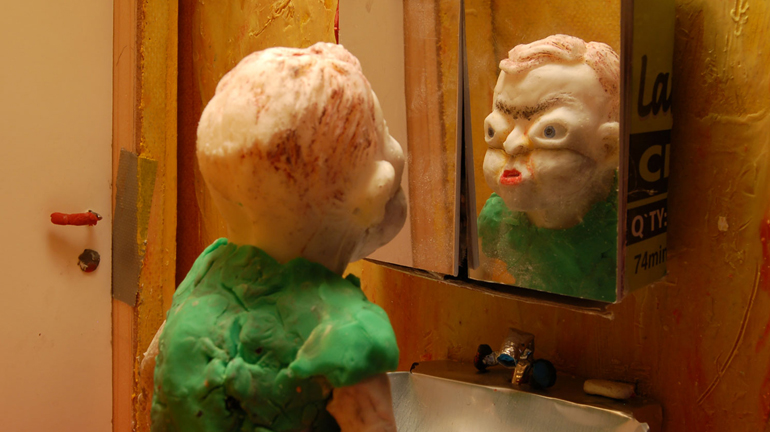
Swedish Music for One Apartment and Six Drummers is probably the best of the lot: both funny and funny funny.
Other delights include Swedish Elixir (that is, a magic formula to transform immigrants into true Swedes); Finnish animation The Irresistible Smile; and Danish Oscar-winning Election Night (which also could be found on Cinema 16: European Short Films collection).
- Las Palmas by Johannes Nyholm (Sweden, 2011, 13 min)
- No Sex Just Understand by Mariken Halle (Norway, 2011, 15 min)
- Äiti ei enää keilaa (Mother Doesn’t Bowl Anymore) by Teemu Nikki (Finland, 2010, 10 min)
- Slitage (Seeds of the Fall) by Patrik Eklund (Sweden, 2009, 18 min)
- This Is Alaska by Mårten Nilsson and Gunilla Heilborn (Sweden, 2009, 10 min)
- Space Monkeys by Jan Rahbek (Denmark, 2008, 8 min)
- Sunday Mornings by Jannicke Låker (Norway, 2008, 9 min)
- Naglinn (The Nail by Benedikt Erlingsson (Iceland, 2008, 16 min)
- Sagan om den lille Dockpojken (The Tale of Little Puppetboy) by Johannes Nyholm (Sweden, 2008, 18 min)
- Anna by Helena Stefánsdóttir (Iceland, 2007, 13 min)
- Occupations by Lars von Trier (Denmark, 2007, 3 min)
- Ilo irti (The Irresistible Smile) by Ami Lindholm (Finland, 2006, 6 min)
- Järvi (The Lake) by Maarit Lalli (Finland, 2006, 9 min)
- Elixir by Babak Najafi (Sweden, 2004, 26 min)
- De beste går først (United We Stand) by Hans Petter Moland (Norway, 2002, 9 min)
- Music for One Apartment and Six Drummers by Ola Simonsen and Johannes Stjärne Nilsson (Sweden, 2001, 10 min)
- Døren som ikke smakk (Shut the Door) by Jens Lien (Norway, 2000, 10 min)
- Valgaften (Election Night) by Anders Thomas Jensen (Denmark, 1999, 11 min)
- Pilot for En duva satt på en gren och funderade på tillvaron (A Pigeon Sat on a Branch - Reflecting on Existence) by Roy Andersson (Sweden, 2011, 8 min)
Thursday, 2 July 2009
Balanço
by Deodato Siquir
Early evening of 9 May 2008, as I was rather aimlessly wandering around Berlin, a dark-haired lady stepped in front of me and addressed me in English. Without much ado, she asked: “Are you free tonight?” As a matter of fact, I was. Not that she left me any time to respond. “Because, you see,” the leaflet was thrusted in my hand so I would see, “there is a jazz concert tonight, and I’d love you to come.” Wow. Was it written on my face that I would be interested? “It is not far from here,” she said, waving her hand somewhere in the behind-my-back direction. (Incidentally, the building just behind my back was Beate Uhse Erotik-Museum. But no, the gig actually was in Quasimodo, Berlin’s oldest jazz club.) “See you tonight at 10.”
That’s how I found myself at the concert of Deodato Siquir & Balanço which was a part of the Copenhagen in Berlin (!) Jazz Festival. “So, you did it after all.” The brunette sounded pleasantly surprised. Apparently, she did a great job: the cellar of Quasimodo was full. And deservedly so.
Balanço is the name of the band as well as Deodato Siquir’s debut album (good thing I bought it then and there: it does not seem to be available at Amazon), and the wonderful salsa-like title song.
Eu quero ver você mexer |  |
Subscribe to:
Posts (Atom)


