Showing posts sorted by relevance for query poirot. Sort by date Show all posts

Thursday, 8 May 2014

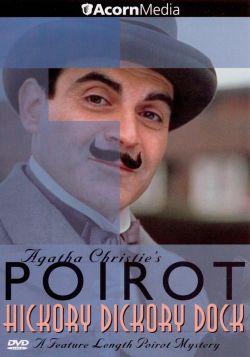
Hickory Dickory Dock

a film by Andrew Grieve

I first saw this episode of Agatha Christie’s Poirot back in mid-1990s. Until I watched it again a few days ago, I couldn’t remember anything at all apart from its glorious finale. The rest of the movie, as I discover now, is not bad either, although the mouse (that ran up the clock) is really annoying.
Hercule Poirot. It is most kind of you to invite me here, Chief Inspector.
Chief Inspector Japp. After staying with you for a whole week, Poirot, the least I could do is offer you a spot of lunch, wean you away from that... well, let you taste some proper English cooking.
Poirot. And the good Madam Japp, it is today that she returns?
Japp. Yes, about three o’clock. There. Now that is what I call food. That’s your mashed potato. This is your peas.
Poirot. Oui.
Japp. Mushy peas, we call ’em. You’ll love ’em. And this, the pièce de résistance... faggots.
Poirot. Faggots?
Japp. Faggots. And there’s spotted dick for afters.
Poirot. Dick?
Japp. Yes, it’s called that because...
Poirot. This is tragic, Chief Inspector.
Japp. No, no, it’s fine.
Poirot. I can eat none of this wonderful food.
Japp. What? Why?
Poirot. Because... I have an allergy of the faggot.
Japp. An allergy?
Poirot. Oui. I do not know how you say it in English but in Belgian it is known as... le phobie de faggot.
Japp. I’ve never heard of that.
Poirot. I am so sorry, Chief Inspector, I should have warned you.
Japp. Well, this is a blessed upset, I must say. Still, you can have some spotted dick. You don’t have a phobie de dick, have you?
Poirot. Non... Some cheese?
Japp. I’ll have a look.
Poirot. Some brie perhaps? Bon.
Japp. Nothing like a nice bit of mouse trap.

Sunday, 19 January 2014

Curtain: Poirot’s Last Case

a film by Hettie MacDonald

Tonight, Yle has treated us to the final episode of Agatha Christie’s Poirot. What?! How could it be? I thought Hercule Poirot is immortal. But here he was, old, ill, wheelchair-bound... as always, expertly portrayed by David Suchet. The rest of cast are great too. Aidan McArdle is excellent (scary!) as Norton, and Hugh Fraser returns as trusty Hastings.

In spite of the overall gloom, quite a few moments made me chuckle — like Poirot confessing (from beyond the grave) that his moustache were fake. I knew it!

Tuesday, 23 June 2026

Murder on the Orient Express

a film by Sidney Lumet
based on a novel by Agatha Christie

Curiously, it took exactly forty years from the publication of Christie’s classic novel to make its first adaptation. Of the three films from the cycle Nada es lo que parece, the last one was the one I liked the least. I found its all-star cast including Ingrid Bergman, Jean-Pierre Cassel, Sean Connery, Anthony Perkins and Vanessa Redgrave rather underwhelming, while Albert Finney portrayed the most annoying Poirot I’ve seen. It is its few comic moments that make this grandiose movie actually enjoyable.

According to Wikipedia,

Christie, who died fourteen months after the release of the film, stated that Murder on the Orient Express and Witness for the Prosecution were the only movie adaptations of her books that she liked although she expressed disappointment with Poirot’s moustache.

Tuesday, 15 September 2020

The great danger of the metric system

First published 15 September 2020 @ low-throughput

A few fact(oid)s about Dame Agatha Christie I haven’t been aware until now.

  • Pharmacy and toxicology were among Christie’s many interests. During the the First World War, she took some time off her work as a nurse to study for the Apothecaries Hall Examination. She wrote in her autobiography:
    To be introduced suddenly to the periodic table, atomic weight, and the ramifications of coal-tar derivatives was apt to result in bewilderment. However, I found my feet, mastered the simpler facts, and after we had blown up our Cona coffee machine in the process of practising Marsh’s test for arsenic our progress was well on the way. <...>
    A chemist’s shop, the first time that you go behind the scenes, is a revelation. Being amateurs in our hospital work, we measured every bottle of medicine with the utmost accuracy. When the doctor prescribed twenty grains of bismuth carbonate to a dose, exactly twenty grains the patient got. Since we were amateurs, I think this was a good thing, but I imagine that any chemist who has done his five years, and got his minor pharmaceutical degree, knows his stuff in the same way as a good cook knows hers. He tosses in portions from the various stock bottles with the utmost confidence, without bothering to measure or weigh at all. He measures his poisons or dangerous drugs carefully, of course, but the harmless stuff goes in in the approximate dollops. Colouring and flavouring are added in much the same way. This sometimes results in the patients coming back and complaining that their medicine is a different colour from last time. <...>
    During the course of my pharmaceutical instruction on Sunday afternoons, I was faced with a problem. It was incumbent upon the entrants to the examination to deal with both the ordinary system and the metric system of measurements. My pharmacist gave me practice in making up preparations to the metric formula. Neither doctors nor chemists like the metrical system in operation. One of our doctors at the hospital never learned what ‘containing 0.1’ really meant, and would say, ‘Now let me see, is this solution one in a hundred or one in a thousand?’ The great danger of the metric system is that if you go wrong you go ten times wrong. <...>
    It was while I was working in the dispensary that I first conceived the idea of writing a detective story.
  • It was not until 1920 that her first novel, The Mysterious Affair at Styles, saw the light of day. The corresponding episode of Poirot was released 30 years ago on occasion of Christie’s 100th birthday. Now, to mark the centenary of Styles, the Royal Mint issued the new £2 coins featuring the author’s signature, a jigsaw puzzle and some instruments of murder.

  • I visited Ayuntamiento de Las Palmas de Gran Canaria on many a bureaucracy-related occasion without knowing that its (pretty ugly) headquarters occupy the place of the former Quiney’s Hotel Metropole where Agatha Christie stayed in 1927.
    Las Palmas is still my ideal of the place to go in the winter months. I believe nowadays it is a tourist resort and has lost its early charm. Then it was quiet and peaceful. Very few people came there except those who stayed for a month or two in winter and preferred it to Madeira. It had two perfect beaches. The temperature was perfect too: the average was about 70, which is, to my mind, what a summer temperature should be.
    Agatha Christie: An Autobiography

  • The Mousetrap was not only the longest-running West End show but it had the longest initial run of any play in history. It premiered in 1952 and ran continuously until March 2020 until it was rudely interrupted by the COVID-19 pandemic.

Saturday, 18 July 2020

Jeeves and Wooster

starring Stephen Fry and Hugh Laurie
screenplay by Clive Exton

This year, Jeeves and Wooster turned 30. I remember seeing couple of the episodes on Russian TV in 1990s. I didn’t get most of the humour back then though. I bought the 21st anniversary edition box when we lived in Finland. In the beginning, the kids were enthusiastic but somehow we never got to the end. Now we did.

Laurie’s Wooster, albeit lovable, seems to be no more than a 20th-century incarnation of that “mad, blundering, incredibly handsome nincompoop”, the Prince Regent, and does not evolve much. On the other hand, Jeeves’s cunning plans and schemes become even more cunning and sophisticated as the series grows progressively sillier. Also, he greatly improves as a musician.

Anyway. We all know that Fry and Laurie are great. But J & W wouldn’t be what it is without the script by Clive Exton — the Poirot Clive Exton, — without the music by that Anne Dudley, and without its supporting cast. John Turner is outstanding as Roderick Spode, 7th Earl of Sidcup, a hilariously Mussoliniesque leader of the Black Shorts. Mary Wimbush makes a truly awesome Aunt Agatha (series 1 through 3), while Elizabeth Morton (series 3 and 4) is the best Madeline (of all three).

You know, the more I see of women, the more I think that there ought to be a law. Something has got to be done about this sex, or the whole fabric of Society will collapse, and then, what silly asses we shall all look.
This is the opinion of Bertie Wooster, of course; there’s no reason to think that P. G. Wodehouse shared it any more than other Wooster’s opinions. As one Honoria Plum (I don’t believe it’s her real name) noted in her blog, the charge against Wodehouse that “women are excluded as complex characters” is
partially correct, but misleading because Wodehouse was simply not in the business of creating complex characters at all.
Just look at the men, other than Jeeves I mean, in the series. And the children. Don’t get me started on children.

As we finished re-watching all of it a week or so ago, we need to find another reasonably well-forgotten comedy series.