Showing posts with label Ukraine. Show all posts

Thursday, 15 February 2024

Поёт Марк Бернес

by Mark Bernes

Very different from Les Grandes Musiques de Films but equally loved by my mum was an LP called simply «Поёт Марк Бернес» (Mark Bernes sings). Since the mid-seventies, although she was perfectly able to put it on the turntable, my mum would rather ask my brother or me to do it. As a result, the vinyl was scratched beyond any reason. So yes, another record I grew up listening to and damaging it in the process.

On the sleeve, a black and white photo of a middle-aged man holding a mike. Back then, I’d probably say “an old man”. Old? The album was released in 1968; Mark Naumovich Bernes (Марк Наумович Бернес) died the following year aged 57.
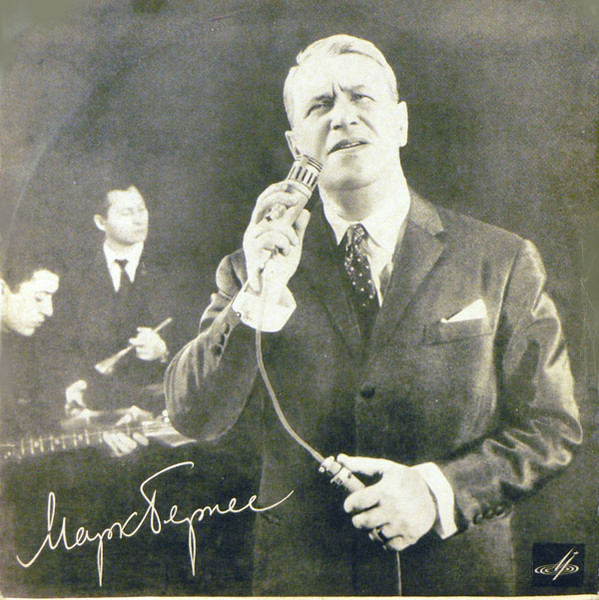
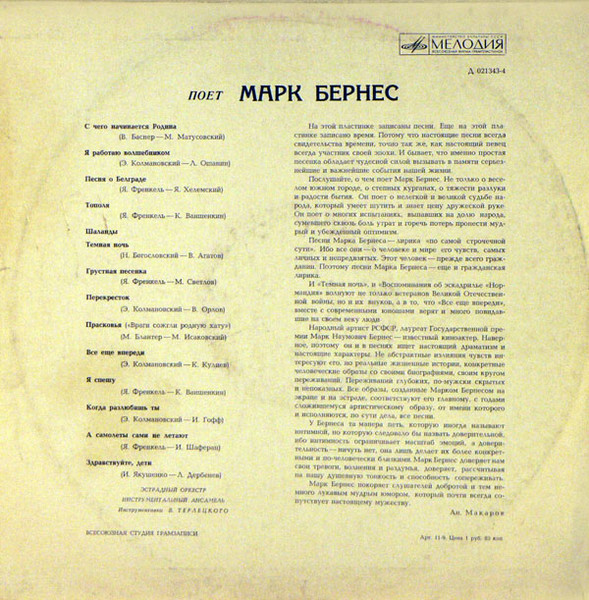
I myself would never call Bernes «певец» (singer) — I felt that word was reserved for the likes of Iosif Kobzon, Lev Leshchenko or Muslim Magomayev. Bernes was a chansonnier. He was not singing his heart out but talking, joking, telling a story.

I can’t listen to this disc now with the same ears as 50 years ago. The opener, «С чего начинается Родина» (What Does the Homeland Begin With), just makes me cringe. I can live with most of the lyrics — I mean, it’s all right, not worse than a typical Anglophone pop song — such as the one of surprisingly jazzy «Всё ещё впереди» (Everything is Still to Come). Two tracks, however, are unquestionable masterpieces: «Тёмная ночь» (Dark is the Night) and «Шаланды, полные кефали» (Scows Full of Mullet)*, both composed by Nikita Bogoslovsky with lyrics by Vladimir Agatov for the 1943 film «Два бойца» (Two Soldiers). The songs in the movie sound quite different from those on the 1968 record. For example, in the “original” «Шаланды» Bernes pronounced the name Odessa as «Одэсса» /ɐˈdɛsːə/ while in the ’60s rendition it’s the normative «Одесса» /ɐˈdʲesːə/. Imprinting and all, I still prefer the latter version.

As for «Тёмная ночь», it deservedly became one of the most famous and beloved Soviet songs created during the Great Patriotic War... and that despite neither being patriotic nor mentioning the war. Yes, we know, the war is raging on — in the film. Bullets, mortal combat, death are all present, but there is no word “war” in the lyrics. And so the song transcends time, place and circumstances. An immortal classic.


* Curiously, the word шаланда comes from the French chaland (barge), and that, in its turn, from Ancient Greek χελάνδιον; кефаль (mullet) from κέφαλος; and Одесса (Odessa) itself was named after the ancient Greek city of Odessos (Ὀδησσός).
According to Nikita Bogoslovsky, «Шаланды», its success notwithstanding, was harshly criticised by Soviet bureaucrats (who likened the song to criminal folklore) and not recommended for official performances.

Tuesday, 12 December 2023

Ми не згаснемо

a film by Alisa Kovalenko

Five teenagers living in a small town in Donbass have a dream. Well, they have a lot of dreams, mostly about the end of the war, or about getting out of this arse end of nowhere. But the most outlandish one is to visit Himalayas.

As it happens, this is the one dream that actually comes true. Pretty unbelievable, I say. And the film, I’m afraid, does not make it believable — a fatal flaw in a documentary. Which is a shame. I can’t blame the director — she interrupted the work on the picture she had been filming for three years when the full-blown Russian invasion of Ukraine started in order to fight on the frontline. It could be that she lost the interest in the film, at least for a while. That she eventually managed to finish it, after coming back, is already a miracle. In any case, the film as envisaged does not exist. The war added a harsh epilogue: three protagonists became refugees; the contact with the remaining two who fell under occupation was lost.

We Will Not Fade Away (rendered in Spanish as “Nosotras, mañana”) was the last Documental del Mes of this year.

Wednesday, 20 December 2017

Cuentos de Odesa

by Isaac Babel
translated by Marta Sánchez-Nieves
illustrated by Iratxe López de Munáin

In spite, or maybe precisely thanks to, his famous surname, Isaac Babel (1894—1940) remains little known in the West. This slim volume, published in 2014, introduces to Spanish readers the first four of Babel’s Tales of Odessa (Одесские рассказы), viz. El rey (Король), Qué sucedió en Odesa (Как это делалось в Одессе), El padre (Отец) and Liubka la Cosaca (Любка Казак), lovingly retold by Marta Sánchez-Nieves and accompanied by some wonderful illustrations by Iratxe López de Munáin. Great work Ediciones Nevsky — I hope the rest of Cuentos follow suit soon!

Los maleantes se miraban, y solo Benia parecía no darse cuenta y estaba desconsolado.
— Me están estropeando la fiesta — gritaba realmente desesperado —, queridos, por favor os lo pido, comed, bebed...
Pero en ese instante apareció en el patio el mismo joven que había venido al empezar la tarde.
— Rey — dijo —, tengo que decirle un par de palabras...
— Bueno, pues dilas — respondió el Rey —, tú siempre tienes un par de palabras de reserva...
— Rey — dijo el joven desconocido, y empezó a soltar risitas —, es que es muy divertido, el cuartel de policía está ardiendo como una vela...
Los comerciantes enmudecieron, los maleantes sonrieron. La sexagenaria Manka, la fundadora de los bandidos de arrabal, se llevó dos dedos a la boca y lanzó un silbido tan estridente que sus vecinos se echaron a un lado.
— Mania, no está en el trabajo — le advertió Benia —, más sangre fría, Mania...
Налётчики переглянулись тогда друг с другом. И только Беня, ничего не замечавший, был безутешен.
— Мине нарушают праздник, — кричал он, полный отчаяния, — дорогие, прошу вас, закусывайте и выпивайте...
Но в это время во дворе появился тот самый молодой человек, который приходил в начале вечера.
— Король, — сказал он, — я имею вам сказать пару слов...
— Ну, говори, — ответил Король, — ты всегда имеешь в запасе пару слов...
— Король, — произнес неизвестный молодой человек и захихикал, — это прямо смешно, участок горит, как свечка...
Лавочники онемели. Налётчики усмехнулись. Шестидесятилетняя Манька, родоначальница слободских бандитов, вложив два пальца в рот, свистнула так пронзительно, что её соседи покачнулись.
— Маня, вы не на работе, — заметил ей Беня, — холоднокровней, Маня...