Showing posts with label Russian music. Show all posts

Friday, 1 May 2026

Free live music and stuff, March—April 2026

Some stuff that I saw in Valencia, Las Palmas de Gran Canaria and Vitoria.

  • 15—19 March: Las Fallas de Valencia, various locations
      This year, compared to the first time I’ve been to the Fallas, I was able to see more and better, thanks to the weather. Even so, I spent most time away from the crowds in the centre, lost in the barrios of Benimaclet, Cabañal and Malvarrosa.

      More photos of Las Fallas @ Shutterstock.
  • 31 March: «Grito de Mujer 2026» @ Casa de Colón, Calle Colón, 1, Las Palmas de Gran Canaria
      A part of the worldwide festival Grito de Mujer. With the participation of Proyecto Interculturalízate, a group of migrant women (with musical collaboration of the Thioune Brothers); writers M.ª del Pino Marrero Berbel, Rosario Ibrahim, Rubén Mettini, Pepa Molina, Carolina Landino, Bönaí Capote and Aghlahoum-Poeta saharaui-Tinduf; singers-songwriters Sara Brito, Daniel Cano, and Virginia Ruiz “La Niña de la Calle”. Presented by Ana Cendrero González.

  • 8 April: «Somethin’ Stupid» @ Palacete Rodríguez Quegles, Calle Benito Pérez Galdós, 4, Las Palmas de Gran Canaria

  • 10 April: «Sinfonía de sinfonías» @ Plaza del Pilar Nuevo, Las Palmas de Gran Canaria
      The final performance of the graduates of the Advanced Conducting Programme (the class of Dr. Ignacio García Vidal) based in the Canary Islands, with La Banda Sinfónica Municipal de Las Palmas de Gran Canaria. Unfortunately the show was interrupted by rain just when the second part started. This is what we heard:
      • Ludwig van Beethoven, Egmont: Overture — conducted by Óscar Manuel Sánchez Benítez
      • Nikolai Rimsky-Korsakov, Scheherazade I. The Sea and Sinbad’s Ship — conducted by Anna Kucherenko Parikova
      • Rimsky-Korsakov, Scheherazade III. The Young Prince and the Young Princess — conducted by Javier López Peña
      The full programme of the concert as it was intended is available here.

  • 18 April: «Puto amor» @ Centro Cívico Langraiz-Oka, Tres de Marzo Parkea, 1, Nanclares de la Oca / Langraiz Oka

  • 25 April: A Contra Blues @ Plaza de la Provincia, Vitoria-Gasteiz
      A fantastic band featuring Jonathan Herrero (lead vocals, acoustic guitar), Víctor López (drums), Héctor Martín Díaz (electric guitar), Matías Míguez (electric bass) and Alberto Noel Calvillo (electric guitar) was performing as part of the Fiestas de San Prudencio. I liked their originals but I was most impressed by the covers of Sinnerman and Triana’s En el lago.

And exhibitions, all in Las Palmas de Gran Canaria:

  • 27 February — 27 March: «Hacer(se) Tierra. Arquitectura del arraigo» @ Centro Cultural CICCA, Alameda de Colón, 1
      Paintings from the collection of La Fundación La Caja de Canarias, including works by Miró Mainó, Alberto Manrique, José Comas Quesada, Pedro del Castillo Olivares and Juan Betancor.

  • 5 March — 10 April: «Prohibido Escuchar» @ Centro de Artes Plásticas (CAP), Calle Colón, 8
      A project by Anarcos and Rosa P. Almeida, with invited artist Pedro Déniz.

  • 19 March — 30 August: «ART AL QUADRAT. Memorias colectivas / Represiones cotidianas» @ CAAM — San Antonio Abad, Plaza San Antonio Abad
      Works by the Valencian arists Mónica and Gema del Rey Jordà, aka Art al Quadrat.

Bring on May.

Sunday, 25 January 2026

Песня о старом доме на Новом Арбате

a song by Vladimir Vysotsky
music by Mikael Tariverdiev

After spending two weeks living in an old and very cold house, this song came to mind, just in time for its author’s 88th birthday. A song about an old house on New Arbat appeared in the 1966 Soviet comedy Саша-Сашенька, of which Vysotsky said that it was “a really bad movie” and that he contributed his song “due to a misunderstanding”. I never watched it. According to Wikipedia, in the film the song was performed by an “unknown actor”. Elsewhere, it is said that the song was ‘written for Tariverdiev’s opera “Who are you?”’ («Кто ты?»). This version on YouTube is that I knew and loved since the 1970s from magnetic tape recordings. Unfortunately I couldn’t find a decent English translation of it.

Владимир Высоцкий
Музыка Микаэла Таривердиева
Песня о старом доме на Новом Арбате
Стоял тот дом, всем жителям знакомый,
Его ещё Наполеон застал,
Но вот его назначили для слома,
Жильцы давно уехали из дома,
Но дом пока стоял...
Холодно, холодно, холодно в доме.

Парадное давно не открывалось,
Мальчишки окна выбили уже,
И штукатурка всюду осыпалась,
Но что-то в этом доме оставалось
На третьем этаже...
Ахало, охало, ухало в доме.

И дети часто жаловались маме
И обходили дом тот стороной.
Объединясь с соседними дворами,
Вооружась лопатами, ломами,
Вошли туда гурьбой
Дворники, дворники, дворники тихо.

Они стоят и недоумевают,
Назад спешат, боязни не тая,
Вдруг там Наполеонов дух витает,
А может, это просто слуховая
Галлюцинация?
Боязно, боязно, боязно дворникам.

Но наконец приказ о доме вышел,
И вот рабочий, тот, что дом ломал,
Ударил с маху гирею по крыше,
А после клялся, будто бы услышал,
Как кто-то застонал
Жалобно, жалобно, жалобно в доме.

От страха дети больше не трясутся:
Нет дома, что два века простоял,
И скоро здесь по плану реконструкций
Ввысь этажей десятки вознесутся —
Бетон, стекло, металл...
Весело, здорово, красочно будет.

Friday, 28 June 2024

Сергей Вальков (1964—1997)

He would have turned 60 today.

Years ago, I wrote a post on the occasion of the 20th anniversary of Sergey’s death. What changed since then?

OK, I fixed a couple of dead links in the Russian Wikipedia article. I couldn’t find any “new” photos of Sergey. Apart from the image from the said article, there’s nothing on the web. Nada. How could that be? Repeats of the same bio, repeats of “download all songs of Sergey Valkov”, more dead links.

And then — suddenly! — this. One photo more!

But wait. A few months ago, I came across some posts by the LiveJournal user electrik-220. And from these... links to the audio archives! Several concerts of Sergey, some from as early as 1982. Plus a memorial concert in 2001. Plus some other discoveries. This is new stuff: all these archives were uploaded in 2023*. The sound quality of most of them leaves much to be desired. There’s nothing we can do about it. This is history.

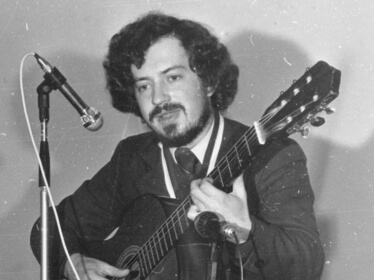
Now, that I sat down to listen, time rewinds. Seryozha, still in his twenties, steps into the room, takes out his trusty Resonata and starts to sing. More like, talk to me.

I’m grateful to all the people (I don’t know any of them) who made this encounter possible. Thank you for keeping the memory and music of Sergey alive.

electrik-220 posts

Archives

Сергей Вальков (Лещина) / Sergey Valkov (Leshchina): himself, solo

Other recordings


* The password to open any rar archive is electrik.
The East German Musima Resonata, which, in the 1980s, was the best classical guitar I could dream of. Sergey bought it second-hand ca. 1980 for a princely sum of 50 roubles.
Some of these archives overlap. «Посвящение Каю» is marked as recorded on 05—06.11.1990. «Песни Кая» includes songs recorded both on 05—06.11.1990 and 16.05.1993. Two archives «из фонотеки Ю. Дёмина» also contain songs from these dates.

Thursday, 15 February 2024

Поёт Марк Бернес

by Mark Bernes

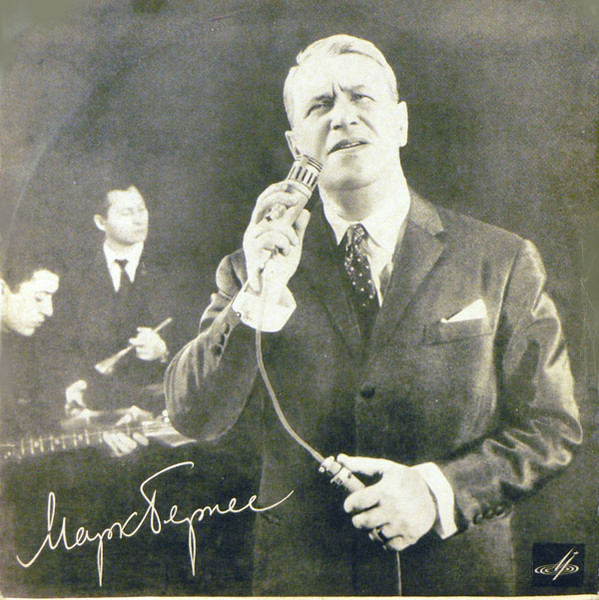
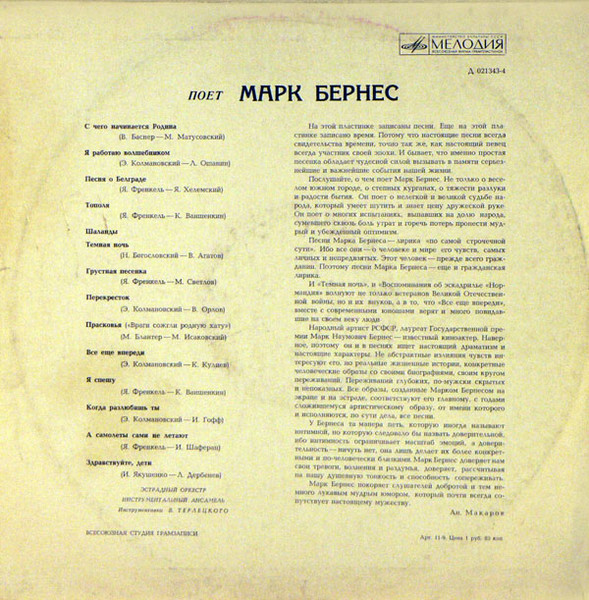
Very different from Les Grandes Musiques de Films but equally loved by my mum was an LP called simply «Поёт Марк Бернес» (Mark Bernes sings). Since the mid-seventies, although she was perfectly able to put it on the turntable, my mum would rather ask my brother or me to do it. As a result, the vinyl was scratched beyond any reason. So yes, another record I grew up listening to and damaging it in the process.

On the sleeve, a black and white photo of a middle-aged man holding a mike. Back then, I’d probably say “an old man”. Old? The album was released in 1968; Mark Naumovich Bernes (Марк Наумович Бернес) died the following year aged 57.

I myself would never call Bernes «певец» (singer) — I felt that word was reserved for the likes of Iosif Kobzon, Lev Leshchenko or Muslim Magomayev. Bernes was a chansonnier. He was not singing his heart out but talking, joking, telling a story.

I can’t listen to this disc now with the same ears as 50 years ago. The opener, «С чего начинается Родина» (What Does the Homeland Begin With), just makes me cringe. I can live with most of the lyrics — I mean, it’s all right, not worse than a typical Anglophone pop song — such as the one of surprisingly jazzy «Всё ещё впереди» (Everything is Still to Come). Two tracks, however, are unquestionable masterpieces: «Тёмная ночь» (Dark is the Night) and «Шаланды, полные кефали» (Scows Full of Mullet)*, both composed by Nikita Bogoslovsky with lyrics by Vladimir Agatov for the 1943 film «Два бойца» (Two Soldiers). The songs in the movie sound quite different from those on the 1968 record. For example, in the “original” «Шаланды» Bernes pronounced the name Odessa as «Одэсса» /ɐˈdɛsːə/ while in the ’60s rendition it’s the normative «Одесса» /ɐˈdʲesːə/. Imprinting and all, I still prefer the latter version.

As for «Тёмная ночь», it deservedly became one of the most famous and beloved Soviet songs created during the Great Patriotic War... and that despite neither being patriotic nor mentioning the war. Yes, we know, the war is raging on — in the film. Bullets, mortal combat, death are all present, but there is no word “war” in the lyrics. And so the song transcends time, place and circumstances. An immortal classic.


* Curiously, the word шаланда comes from the French chaland (barge), and that, in its turn, from Ancient Greek χελάνδιον; кефаль (mullet) from κέφαλος; and Одесса (Odessa) itself was named after the ancient Greek city of Odessos (Ὀδησσός).
According to Nikita Bogoslovsky, «Шаланды», its success notwithstanding, was harshly criticised by Soviet bureaucrats (who likened the song to criminal folklore) and not recommended for official performances.

Thursday, 25 January 2024

Холода

a song by Vladimir Vysotsky
English lyrics by Mika Tubinshlak

It’s been cold outside, innit? Even here in Canarias it’s pretty chilly by night. So this song came up in my memory.

В холода, в холода...

Of course Vysotsky would normally accompany himself on the guitar, but this jazz-waltz version recorded with Georgy Garanian’s big band Melodia (Мелодия) is exquisite. As I just have learned from Russian Wikipedia, in 2009 Garanian founded the jazz festival «Играем джаз с Гараняном» (“Playing jazz with Garanian”) which has been taking place annually on 25 January!

I’ve found a number of English translations which render the words «в холода» as “to the cold”, “into cold”, or “into the cold”. Oh dear. «В холода» really means “when it’s cold” (outside), “in cold weather”. This is a completely different meaning of the preposition «в»! And even if we wanted to go to a colder place, neither Minsk nor Brest would do: they are normally warmer in winter than, say, Moscow. I like the re-interpretation of this song by Mika Tubinshlak: not literal (for example, he swaps the cold for the mist and rain) but quite poetic and true to the spirit.

Владимир Высоцкий
Холода
Vladimir Vysotsky, Mika Tubinshlak (translation)
Through the mist
В холода, в холода,
От насиженных мест
Нас другие зовут города,
Будь то Минск, будь то Брест,
В холода, в холода.

Неспроста, неспроста,
От родных тополей
Нас суровые манят места,
Будто там веселей.
Неспроста, неспроста...

Как нас дома ни грей,
Не хватает всегда
Новых встреч нам и новых друзей,
Будто с нами беда,
Будто с ними теплей.

Как бы не было нам
Хорошо иногда,
Возвращаемся мы по домам.
Где же наша звезда?
Может — здесь, может — там...
Through the mist, through the rain
From our sheltering nest
Other places are calling our names
To the east, to the west,
Through the mist, through the rain.

Home is where we belong
But we hear them again
Distant voices we’ve known all along
Like the missing refrain
From an old favourite song.

And it seems, yes it seems
Live can be so much more
New adventures and friendships and dreams
Once we walk through the door
So it seems, so it seems.

But no matter how clear,
How light-hearted we are
Home is waiting, and we reappear.
Where is our lucky star?
Maybe there, maybe here...

Monday, 1 May 2023

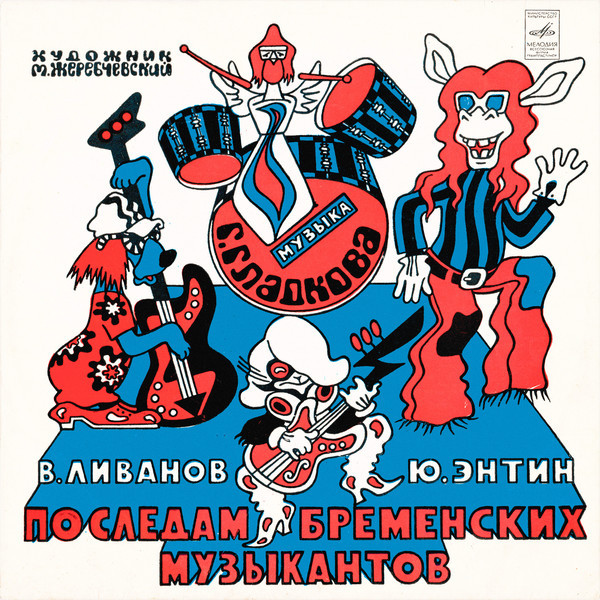
По следам бременских музыкантов

a musical by Yuri Entin, Vasily Livanov and Gennady Gladkov
a film by Vasily Livanov

Speaking of 50th anniversaries: here’s another one for you. For me too.

Just like it was in the case of its prequel, I first heard On the Trail of the Bremen Town Musicians on the vinyl. Once again, it was a gift from my cousin who came to visit us one weekend. I still remember the magical moment when he put the disc on a turntable and we heard the words, read by Oleg Tabakov:

Давным-давно на белом свете жили не только глупые короли и прекрасные принцессы, не только страшные лесные разбойники и весёлые бродячие артисты, но и гениальные сыщики.
Long, long ago, there lived not only silly kings and beautiful princesses, not only scary forest robbers and merry wandering actors, but also genius detectives.

The musical turned out to be even bigger box of surprises than its predecessor. I certainly did not expect Muslim Magomayev — an establishment singer à la Iosif Kobzon and Lev Leshchenko — to be there. And there he was, voicing not only Troubadour, who, indeed, sounds like the “official” Magomayev, but also his antagonists: Genius Detective (Гениальный Сыщик), with his catchphrase “Oh, yes!”, and Atamansha (Атаманша), the leader of Scary Forest Robbers.

My mum used to quote Genius Detective («А нюх как у собаки, а глаз как у орла»), Silly King («Такая, сякая, сбежала из дворца») and Beautiful Princess («Ни-че-го я не хо-чу»). The two songs that the Bremen Town Musicians perform when posing as “foreign” (as opposed to their native Bremenland) rockers were a staple of my brother’s band repertoire in the early 1980s. Many years later, Yuri would call «сыщик» any vintage convertible reminiscent of the car that Genius Detective drives in the film.

Friday, 24 February 2023

Ночной дозор

by Alexander Galich

As I’ve mentioned some time years 10 years ago, in 1977 I expanded my cultural horizons a lot. To a large degree, the said expansion was thanks to my cousin who, in early summer of that year, entrusted us — that is, my brother and me — with a leather briefcase full of magnetic tape reels. For safekeeping. He specifically asked us to refrain from listening a couple of reels which were stored in unmarked boxes. (They are for a very small circle of listeners, he explained.) So we spent a happy summer discovering new for us music, mostly prog-rock, of which later. Of course, it was only a matter of (rather short) time before the temptation won. We were careful enough to make sure our mum wasn’t anywhere near when we explored the forbidden tapes.

That’s how we got acquainted with the works of Galich. Even though back then I didn’t know much about the things Galich was talking about, his songs sounded true. Аве Мария, На сопках Манчжурии, Вальс, посвященный уставу караульной службы, Караганда... And this one: Ночной дозор. Painfully true. Goosebumpingly true. Dangerously true. (About a very small circle of listeners, we got it. And kept quiet about it.) Wait. They still give me goosebumps.

I couldn’t find when exactly Ночной дозор was written but a number of web sites point on the year 1963, or “between 1962 and 1964”. In any case, Ночной дозор sounds even more true now than 60 years ago. At least that’s what I thought when I read about unveiling a bronze bust of Stalin in Volgograd earlier this month.

The English translation by Gerald Stanton Smith thanks to this website.

Александр Галич
Ночной дозор
Alexander Galich, translated by Gerald Stanton Smith
The Night Watch
Когда в городе гаснут праздники,
Когда грешники спят и праведники,
Государственные запасники
Покидают тихонько памятники.
Сотни тысяч (и все — похожие)
Вдоль по лунной идут дорожке,
И случайные прохожие
Кувыркаются в «неотложке».

И бьют барабаны!..

На часах замирает маятник,
Стрелки рвутся бежать обратно:
Одинокий шагает памятник,
Повторённый тысячекратно.
То он в бронзе, а то он в мраморе,
То он с трубкой, а то без трубки,
И за ним, как барашки на море,
Чешут гипсовые обрубки.

И бьют барабаны!..

Я открою окно, я высунусь,
Дрожь пронзит, будто сто по Цельсию!
Вижу: бронзовый генералиссимус
Шутовскую ведёт процессию.
Он выходит на место лобное —
Гений всех времен и народов! —
И, как в старое время доброе,
Принимает парад уродов.

И бьют барабаны!..

Прёт стеной мимо дома нашего
Хлам, забытый в углу уборщицей, —
Вот сапог громыхает маршево,
Вот обломанный ус топорщится.
Им пока — скрипеть да поругиваться,
Да следы оставлять линючие,
Но уверена даже пуговица,
Что сгодится ещё при случае!

И будут бить барабаны!..

Утро родины нашей розовое,
Позывные летят, попискивая.
Восвояси уходит бронзовый,
Но лежат, притаившись, гипсовые.
Пусть до времени покалечены,
Но и в прахе хранят обличие.
Им бы, гипсовым, человечины —
Они вновь обретут величие!

И будут бить барабаны!..
When the town celebrations fade away,
The unrighteous and righteous in bed asleep,
Those the state has put by for a rainy day
Step down quietly from their pedestals.
In their hundreds of thousands, identical,
Along moonlit paths they go pacing,
And the odd belated pedestrians
Dive for shelter in first-aid stations.

And drums are a-drumming!

Clock pendulums freeze, stand motionless,
The hands on their faces pull backwards,
A uniform statue with soldier’s step
Marches out, repeated in thousands.
Some of marble, and some of brass made,
Some are holding that famous pipe,
Alabaster ones, shattered fragments,
Itch to follow, like white-flecked tide.

And drums are a-drumming!

I lean out from my window, shivering
With a fever, one hundred Celsius,
As the brazen generalissimo
Heads a pageant of fools and jesters.
He climbs up on the hallowed podium,
“Of all peoples and ages the genius”,
And salutes a parade of monsters,
As he did in those days so dear to us.

And drums are a-drumming!

By the wall of the block my flat’s in,
Among heaps of abandoned dust and trash,
You can make out a goose-stepping jackboot,
And a broken-off piece of moustache.
For the moment, they creak, drop a curse or two,
Now, they only leave fading traces,
But the last little button’s certain to
Come in useful again on occasion.

And the drums will be drumming!

Dawn’s pink fingers suffuse our motherland,
Station callsigns ping down the radio waves,
The bronze statue returns to its place of rest,
Alabaster ones stay in their hideaways.
Maybe crippled, just temporarily,
But their fragments retain the makings,
Alabaster only needs humankind,
And again it will rise to greatness!

And the drums will be drumming!

Wednesday, 25 January 2023

Broom Besoms / Наш старый дом

by Robert Burns and Samuil Marshak
a song by Alexander Gradsky

Наш старый дом was recorded by Gradsky and Skomorokhi between 1971 and 1974, released on the EP Александр Градский и ансамбль «Скоморохи» in 1978 and had been a staple of his live shows ever since. It’s another one of his songs based on a poem by Burns although with a few twists.

In Marshak’s classical translation, the song is subtitled “На мотив народной песни «Покупайте веники»” (“To the tune of the folk song Buy broom besoms”); the refrain “Buy broom besoms!” appears as an epigraph. By some reason, Marshak omitted the last stanza, “Be she green or gray”. In his turn, Gradsky dropped the “brooms” whatsoever replacing them with his own refrain: “Наш старый дом, хорошо нам будет в нём” (“Our old house, we’ll be just fine there”). While this latter seemingly has nothing to do with Burns’ (or Marshak’s) poem, at the same time it’s very much in the style of Burns.

    Александр Градский: вокал, гитара
    Юрий Иванов: бас-гитара
    Сергей Зенько: флейта, дудка, саксофон
    Юрий Фокин: барабаны
    Alexander Gradsky: vocals, guitar
    Yuri Ivanov: bass guitar
    Sergey Zenko: flute, pipe, saxophone
    Yuri Fokin: drums

But wait. It looks like Broom Besoms was not even written by Scotland’s favourite son. In vain was I scouring my trusty little book The Poetical Works of Robert Burns (Oxford University Press, 1915) for it. The Complete Works published by Burns Country does not have it either. Why? Ralph McLean commented:

It is unlikely that Burns originally wrote these couplets, instead they are more likely to have been traditional pieces which he collected.
The buying of brooms was a common Scottish metaphor for female sexual adventures.
The alternate verses of this song continue the overt phallic symbolism of the previous version, but this time do so from the perspective of a man who still has the desire but not the ability to function as he once did.

“Overt phallic symbolism”? Well I never. I find both versions of the song (marked at the BBC web site as containing “some scenes of a sexual nature”) rather tame, especially by Burns’ standard — cf. the alternate version of the famous Comin’ Thro’ the Rye.

I don’t know if Gradsky, in the pre-internet era, was familiar with the aforementioned folk tune, which you can hear here interpreted by Annie Grace, Karine Polwart and Corrina Hewat. In any case, he came up with very different music.

Robert Burns
Broom Besoms
Роберт Бёрнс, перевод С.Я. Маршака
Песня
на мотив народной песни «Покупайте веники»
Chorus:
Buy broom besoms!
Wha will buy them now?
Fine heather ringers,
Better never grew.
Покупайте веники!
Вот хороший веник.
Веничек из вереска.
Не жалейте денег!
I maun hae a wife,
Whatsoe’er she be;
An she be a woman,
That’s eneugh for me.
Мне нужна жена —
Лучше или хуже,
Лишь была бы женщиной,
Женщиной без мужа.
If that she be bony,
I shall think her right:
If that she be ugly,
Where’s the odds at night?
Толстая, худая —
Это всё равно.
Пусть уродом будет —
По ночам темно.
O, an she be young,
How happy shall I be?
If that she be auld,
The sooner she will die.
Если молодая,
Буду счастлив с нею.
Если же старуха,
Раньше овдовею.
If that she be fruitfu’,
O! what joy is there!
If that she be barren,
Less will be my care.
Пусть детей рожает, —
Было бы охоты.
А бездетной будет —
Меньше мне заботы.
If she like a drappie,
She and I’ll agree;
If she dinna like it,
There’s the mair for me.
Если любит рюмочку,
Пусть не будет пьяница.
А не любит рюмочки —
Больше мне останется!
Be she green or gray;
Be she black or fair;
Let her be a woman,
I shall seek nae mair.

Sunday, 8 May 2022

Zimna wojna

a film by Paweł Pawlikowski
Сколько слов и надежд, сколько песен и тем
Горы будят у нас и зовут нас остаться.
Но спускаемся мы — кто на год, кто совсем,
Потому что всегда, потому что всегда мы должны возвращаться.
Владимир Высоцкий, «Прощание с горами»

“We must always return”, sang Vysotsky. The word должен, however, literally means “indebted”. To whom do we owe our return? To our friends and lovers, certainly; to our family, maybe. But to our fatherland? No, thank you.

The last time I’ve been to my native country was in 1996. A former colleague of mine asked, “Tell me, what are you doing here? We have to come here to die.” But I digress before even starting. Where were we? Ah, yes.

Yesterday, La 2 treated us to Cold War. Starring Joanna Kulig as Zula and Tomasz Kot as Wiktor, this story of impossible love is as beautiful as it is poignant. The movie’s leitmotif, Dwa serduszka, cztery oczy, evolves from a folk song, strikingly performed by an unnamed dark-eyed girl, to a sleek cool jazz ballad. The finale could be a nod to Wajda’s Chronicle of Amorous Accidents as well as to a scene from Tarkovsky’s Mirror. A modern classic.

Friday, 25 February 2022

Солдаты группы «Центр»

a song by Vladimir Vysotsky

I first heard this song in the mid-1970s. It gave me goosebumps. I never thought it will be relevant ever again. But here we are: another führer, another Army Group Centre, another Blitzkrieg. «Не надо думать — с нами тот, кто всё за нас решит.»

Солдат всегда здоров,
Солдат на всё готов,
И пыль, как из ковров,
Мы выбиваем из дорог,

И не остановиться,
И не сменить ноги,
Сияют наши лица,
Сверкают сапоги!

По выжженной равнине,
За метром метр,
Идут по Украине
Солдаты группы «Центр».

На «первый-второй» рассчитайсь —
Первый-второй!
Первый, шаг вперёд! — и в рай
Первый-второй...

А каждый второй —
Тоже герой,
В рай попадёт
Вслед за тобой —
Первый-второй, первый-второй, первый-второй...

А перед нами всё цветёт,
За нами всё горит.
Не надо думать — с нами тот,
Кто всё за нас решит.

Весёлые, не хмурые,
Вернёмся по домам,
Невесты белокурые
Наградой будут нам!

Всё впереди, а ныне —
За метром метр,
Идут по Украине
Солдаты группы «Центр».

На «первый-второй» рассчитайсь —
Первый-второй!
Первый, шаг вперёд! — и в рай
Первый-второй...

А каждый второй —
Тоже герой,
В рай попадёт
Вслед за тобой —
Первый-второй, первый-второй, первый-второй.

Tuesday, 25 January 2022

La fin du bal / Il volo interrotto / Прерванный полёт

a song by Vladimir Vysotsky
French lyrics by Maxime Le Forestier
Italian lyrics by Sergio Secondiano Sacchi

Unbelievably, until now I was not aware of this version sung by the author in French.

The (Russian-language) original was composed by Vysotsky for the 1975 sci-fi drama The Flight of Mr. McKinley (Бегство мистера Мак-Кинли) but was left out of the movie. The widely accepted name Прерванный полёт appears to be a back-translation of Le Vol Arrêté, the title of the song on the 1977 French LP Vladimir Vissotsky and the 1981 (posthumous) album Le Vol Arrêté; Vysotsky himself used to announce the song as Недолюбил. The phrase “прерванный полёт” does not appear anywhere in the lyrics.

According to Russian Wikipedia, the author was not quite satisfied with Le Forestier’s translation. (Yes it’s far from being true to the letter; for one, the words “la fin du bal” do not correspond to anything in the Russian text.) But here it is, arguably the most popular Vysotsky song among the Francophone performers. Its Italian counterpart, Il volo interrotto, translated by Sergio Secondiano Sacchi, has been interpreted by the likes of Franchesco Guccini and Eugenio Finardi. I’m sure Vladimir Semyonovich would approve of this wonderful “acquired in translation” bit:

Он начал робко — с ноты «до»,
но не допел ее, не до...
Ed intonò la voce in “la
la nota non andò più in la...

It probably won’t surprise you that my favourite interpretations of the Russian original is the one by Alexander Gradsky who sadly passed away last year.

Thursday, 30 September 2021

Live music in Santander, September 2021

I don’t get to Facebook much lately. Yet, without it I’d probably miss all the live events I’ve been to this month.

  • 9 September: Queralt Lahoz @ Teatro CASYC, calle Tantín 25, Santander
      Some time ago, a friend of mine shared with me a video which I liked very much. I went to the artist’s Facebook page and saw this poster:

      A couple of weeks later I decided to feature the aforementioned video on my other blog and did a bit of research, only to discover that Queralt is playing in Santander as a part of the cycle Excéntricos 2021. That was one of the “to be announced” dates of the poster. In a company of Pau García (keyboards), Marc Soto (drums) and Fede Jahzzmvn (DJ), Queralt was presenting her debut LP, Pureza, that mixes flamenco, hip-hop and electronica in a fresh and unexpected manner. Well worth the €5 I paid for the ticket.
  • 23 September: La Otra @ Rvbicón, Calle del Sol 4
      Finally, live music in Rvbicón — and I learn about it from La Otra’s Facebook page a day before the event, by which time all the (free) tickets for both 19:00 and 21:00 sets are long gone. And so, Thursday after work, while I was thinking whether it’s worth it to try my luck and wait for the last-minute cancellations, should I go home first etc. etc., my feet brought me to calle del Sol... Not-so-long story short, I found myself inside, at my favourite seat next to the scene, enjoying the show. On this occasion, La Otra was accompanied by Pablo Levin on percussion.

  • 24 September: Chebú @ Escenario Santander, Avenida de la Constitución 39 (Parque de las Llamas)
      I only learned about this concert celebrating the tenth anniversary of Chebú’s debut album thanks to the personal invitation by the band (via Facebook); otherwise, the publicity for the event was non-existent. A magnificent performance by Zhenya Popova (vocals), Nahúm Cobo (piano, guitar), Iván Velasco (guitar), Dani Simons (bass), Miguel San Emeterio (cello) and “Charly” Pérez (drums), with a special guest Phil Grijuela (guitar, vocals).

  • 25 September: Flaca and the Beat @ Escenario Santander
      Were it not for Chebú, I wouldn’t return to ES the following evening to see Flaca and the Beat, and still live happily. The line-up is Miriam Manzanares (vocals, guitar), Matt Green (drums) and Tomás Monago (bass), all ex-Havana Moon, plus Jaime C. Montes (sax) and Pablo Alvear (guitar). It’s not that they were bad, but rather underwhelming, and played way too long. Still, it’s a shame that so few people turned up for a free Saturday night rock’n’roll.

Looking forward to more live music in October.

Sunday, 9 May 2021

Владимир Качан (1947—2021)

Vladimir Kachan (Владимир Качан), a Russian theatre and film actor and a singer-songwriter, died on 7 May.

One of his best-known songs is Оранжевый кот (Orange Cat) with the lyrics by Leonid Filatov. Until today, it was the only song I knew for sure to be written by Kachan.

I think everybody from my generation (and at least ±1 generation) knew the song from Звезда пленительного счастья, but I learned only now that it was Kachan singing.

What I do remember very well was his appearance in the Soviet TV programme Вокруг смеха in a duo with Lyudmila Cherepanova (Людмила Черепанова).

Monday, 25 January 2021

John Barleycorn

by Robert Burns and Samuil Marshak
a song by Edison Denisov

I first heard this song in the mid-1970s performed by Lyudmila Maksakova (Людмила Максакова) in the Soviet television play «Театр Клары Газуль» based on Prosper Mérimée’s Théâtre de Clara Gazul. I had no clue what it was all about. Beer!

Of course, Burns poem is just one of the versions of the English folk song. (One of my favourite renditions is the one by The Imagined Village.) In order to “Scottify” it, Burns incorporated a clumsy rhyme “hand” / “Scotland” into the last stanza. To me, it sounds incredibly false. Good thing Marshak got rid of it.

Who are Burns’s “three kings into the east” (Marshak kept them)? No idea. In English version, “There were three men came out of the West”. Some foreigners, I imagine. Irishmen perhaps?

.
Robert Burns
John Barleycorn
Роберт Бёрнс, перевод С.Я. Маршака
Джон Ячменное Зерно
There were three kings into the east,
Three kings both great and high,
An’ they hae swore a solemn oath
John Barleycorn should die.
Трёх королей разгневал он
И было решено,
Что навсегда погибнет Джон
Ячменное Зерно.
They took a plough and plough’d him down,
Put clods upon his head,
And they hae swore a solemn oath
John Barleycorn was dead.
Велели выкопать сохой
Могилу короли,
Чтоб славный Джон, боец лихой,
Не вышел из земли.
But the cheerful Spring came kindly on,
And show’rs began to fall;
John Barleycorn got up again,
And sore surpris’d them all.
Травой покрылся горный склон,
В ручьях воды полно...
А из земли выходит Джон
Ячменное Зерно.
The sultry suns of Summer came,
And he grew thick and strong;
His head weel arm’d wi’ pointed spears,
That no one should him wrong.
Все так же буен и упрям
С пригорка в летний зной
Грозит он копьями врагам,
Качая головой.
The sober Autumn enter’d mild,
When he grew wan and pale;
His bending joints and drooping head
Show’d he began to fail.
Но осень трезвая идёт
И, тяжко нагружён,
Поник под бременем забот,
Согнулся старый Джон.
His colour sicken’d more and more,
He faded into age;
And then his enemies began
To show their deadly rage.
Настало время помирать —
Зима недалека.
И тут-то недруги опять
Взялись за старика.
They’ve ta’en a weapon, long and sharp,
And cut him by the knee;
Then tied him fast upon a cart,
Like a rogue for forgerie.
Его свалил горбатый нож
Одним ударом с ног,
И как бродягу на правёж,
Везут его на ток.
They laid him down upon his back,
And cudgell’d him full sore;
They hung him up before the storm,
And turn’d him o’er and o’er.
Дубасить Джона принялись
Злодеи поутру.
Потом, подбрасывая ввысь,
Кружили на ветру.
They filled up a darksome pit
With water to the brim;
They heaved in John Barleycorn,
There let him sink or swim.
Он был в колодец погружён,
На сумрачное дно.
Но и в воде не тонет Джон
Ячменное Зерно!
They laid him out upon the floor,
To work him farther woe;
And still, as signs of life appear’d,
They toss’d him to and fro.
They wasted o’er a scorching flame
The marrow of his bones;
But a miller us’d him worst of all —
He crush’d him ’tween two stones.
Не пощадив его костей,
Швырнули их в костёр.
А сердце мельник меж камней
Безжалостно растёр.
And they hae taen his very heart’s blood,
And drank it round and round;
And still the more and more they drank,
Their joy did more abound.
Бушует кровь его в котле,
Под обручем бурлит,
Вскипает в кружках на столе
И души веселит.
John Barleycorn was a hero bold,
Of noble enterprise;
For if you do but taste his blood,
’Twill make your courage rise.
Недаром был покойный Джон
При жизни молодец, —
Отвагу подымает он
Со дна людских сердец.
’Twill make a man forget his woe;
’Twill heighten all his joy;
’Twill make the widow’s heart to sing,
Tho’ the tear were in her eye.
Он гонит вон из головы
Докучный рой забот.
За кружкой сердце у вдовы
От радости поёт...
Then let us toast John Barleycorn,
Each man a glass in hand;
And may his great posterity
Ne’er fail in old Scotland!
Так пусть же до конца времён
Не высыхает дно
В бочонке, где клокочет Джон
Ячменное Зерно!

Monday, 5 October 2020

Русские песни

by Alexander Gradsky

Русские песни were recorded in 1976—1979 and released on LP in 1980. I can’t find more precise date, so why not 5 October.

I remember how it appeared in our house. One of my mum’s former students worked at the Aprelevka record factory and was procuring the vinyls before they hit the stores. As for Русские песни, I never saw it in the stores. Some of those vinyls came in faceless paper sleeves or just in plastic “inner” bags, but this one came in a proper cardboard sleeve, with the title and song names in both Russian and English. Wow.

Till then, I only knew Gradsky thanks to Как молоды мы были and his work in the animated film Голубой щенок. (Mind you, “only” this would be enough to secure him a place in the music pantheon.) I never imagined him to be a rock musician. The title, Russian songs, was not particularly promising. I was not a big fan of Russian folk songs because what we heard on the radio or TV back then were of the official (castrated) variety — Alexandrov Ensemble, Lyudmila Zykina, Pyatnitsky Choir. Surely Gradsky wouldn’t sing any of those, I thought. So, when nobody was home, I gave it a listen. And then another one. And another one.

This album was a revelation. Of course, now I can’t think of any other version of any of these songs, nor any other sequence. And it is recommended (by me) to make a pause between “side A” and “side B” even if you listen to the CD. They were recorded three years apart (side A in 1976, side B in 1979) and each has its own beginning and end.

One detail that I haven’t known until now is that it was Yuri Fokin (Skomorokhi, Tsvety, Mashina Vremeni) who played drums on 1976 sessions. As he emigrated to the USA in 1978, his name didn’t appear in the album credits — typical in the Soviet times, but this omission was not corrected on the 1995 CD either.

Русские песни / Russian Songs
Сюита на темы народных песен / Folk song suite
  1. Ничто в полюшке
  2. Дарю платок (страдания)
  3. Таня белая (хоровод-танок)
  4. Плач
  5. На Ивана Купала
  6. Не одна во поле дороженька
  7. Солдатская
  8. Вы жертвою пали
    Александр Градский: вокал, гитара, клавишные, колокола, ударные
    Юрий Иванов: бас-гитара, гармоника
    Сергей Зенько: флейта, дудка, саксофон
    Юрий Фокин: барабаны (1, 2, 5)
    Владимир Васильков: барабаны (7)
    Alexander Gradsky: vocals, guitar, keyboards, bells, percussion
    Yuri Ivanov: bass guitar, accordion
    Sergey Zenko: flute, pipe, saxophone
    Yuri Fokin: drums (1, 2, 5)
    Vladimir Vasilkov: drums (7)

Saturday, 12 September 2020

Klezmer: 2. Feliz aniversario, Scylla

by Joann Sfar
translated by Manel Domínguez

So this was the first Klezmer book that I read, before La Conquista del Este. And I liked it more than the vol. 1. Why? The vol. 1 reads more like a prequel, with too many events squeezed together to explain the whos and whys of the band. Feliz aniversario, Scylla lasts just one night. The plot is both incredible and convincing. (Even the visit of the Angel of Death is convincing.) Ditto the inner story of cossack Raki and talking wolf, narrated by Tchokola — unlike the other Tchokola’s tales, where he is just taking the piss. And the scene of Hava and Yaacov in a bathtub together is as sensual as it is hilarious.

The author’s notes, once again, are very much worth reading, even though it means (once again!) struggling with that lettering. This time, Sfar talks about watercolour and what he learned from his heroes and brothers-in-arms: Christophe Blain, Emmanuel Guibert, Gipi and Quentin Blake.

Sunday, 6 September 2020

Klezmer: 1. La Conquista del Este

by Joann Sfar
preface by Marc-Alain Ouaknin
translated by Manel Domínguez

I discovered this book thanks to Pascin, the earlier work by Sfar. Or, rather, first I discovered, and then read, Klezmer vol. 2, thanks to Pascin, and only after that found (and read) Klezmer vol. 1.

I loved the pen and watercolour drawings, very different from black-and-white ones in Pascin. Some of them reminded me of Quentin Blake’s illustrations; the others are darker, bolder affairs. But all unmistakably Sfar. As Rabbi Ouaknin says in the preface: “Sfar draws in Yiddish like others speak it”. I loved the the author’s sense of humour. I loved the quotes from Babel. The only thing I’m not quite happy with is lettering — some words were a bit of a challenge to decipher! Perhaps the challenge was intended.

So find and read it, in whatever language you can. And don’t forget the notes in the end. It seems that Joann Sfar, apart from being a comics artist, novelist, actor and film director, is also a musician. If you feel inspired and would like to try your hand at klezmer, Sfar recommends The Compleat Klezmer (Tara Publications) book by Henry Sapoznik and music from the accompanying CD.

Play list
(from the author’s notes)