Thursday, 11 September 2014

Buying textbooks in Spain

Unlike the UK or Finland, where the school textbooks are provided free of charge, in Spain one has to buy them; at least, most of them. And they ain’t cheap. For example, for his first year Bachillerato, Yuri needs six (6) books, each priced about €30 in the bookshop, except for Historia del Mundo Contemporáneo which costs €42! You can save a few euros shopping at Amazon.es; unfortunately, they don’t offer free shipping for Canaries. Moreover, I found one of the textbooks sold slightly cheaper by a vendor via Amazon.es but there was no option to deliver to Canaries at all.

So I decided to explore the second-hand market. In Fuerteventura, there are no second-hand shops; at least, when we lived there, they did not exist. There are a few in Las Palmas, but I don’t know any specialised bookshops. However I was able to find all the books for Yuri at segundamano.es. (I used the same website a few months ago when I was looking for a house to rent.) I thought the most difficult part for me would be arranging meetings with the sellers: I hate phoning! It turned out to be a fun way of practicing my Spanish. To pick up one of the books, I had to take a bus to hitherto unknown (to me) part of Las Palmas, where I explored streets named Calle Polca and Calle Mazurca.

There is quite a diversity of school textbooks in Spain: you don’t just buy a math textbook for the 3º ESO, you need a specific one. And they tend to require the newer editions every year. Good news that some of Bachillerato books stayed the same for several years. I mean, there was not too much progress with Ancient Greek or Latin recently.

Finding the second-hand books for Timur was a bit more tricky. Luckily, I discovered Relibrea, an excellent web site dedicated to buying/selling of second-hand books. There was nothing available in Gran Canaria but eventually I found the sellers ready to send me the books from Madrid.

Result: of the lot (twelve textbooks altogether), the most expensive book did cost me €16 (plus postage), the cheapest €8; total saving at least €200.

Thursday, 4 September 2014

Wabi-Sabi

by Francesc Miralles

Speaking of coincidences: the other day Tamara mentioned the concept of wabi-sabi which, in its turn, had appeared in somebody else’s blog. “Do you know what wabi-sabi is?” — “Yes. As it happens, I am in the middle of a book entitled Wabi-Sabi”.

Incidentally, Wabi-Sabi was the first book that I had borrowed from the library of Las Palmas. I did not know anything about its author nor its topic, but I loved the sub-title: “Una novela sobre la belleza de lo imperfecto y lo efímero”. Also, it was the first novel which I had read in Spanish from beginning to the end without any on-line help. This is, without doubt, thanks to the author’s easy style of writing. (The fact it is short and written in short chapters helped as well.)

The adventures start when Samuel, the university professor of German in his mid-forties, receives a postcard from Japan with a picture of a lucky cat, maneki-neko, and a strange message:

Wabi-Sabi

I’m afraid I can’t tell you what happens next. Unlike its prequel, amor en minúscula (Love in Small Letters), Wabi-Sabi is not published yet in English. You better believe me that it’s good. Not perfect though: perfection would be very un-wabi-sabi. (Miralles’s liberal use of imperfect, I’m afraid, will be completely lost in English translation.) It has solitude, love and the end of love, songs in English, Japanese and the language of Atlantis (!), gentle humour and even some sort of happy end — again, as long as its imperfection, transience and incompleteness are accepted.

Here’s my favourite part. Samuel walks in a tiny bar in Kioto. The only other customer, an elderly gentleman contemplating an almost empty bottle of sake, all of a sudden bursts out singing.

La camarera subió el volumen para que el hombre pudiera cantar a placer sobre unos acordes sincopados que recordaban a la música popular rusa. La melodía vocal era muy repetitiva y kitsch, más aún viniendo de aquel ejecutivo que parecía haber huido de una pelea de gatos.

dokonoko no kinoko kono kinoko dokono
dokonoko no kinoko morino kinoko
morino kinoko wa rappa ni natte
onpu kumo made tondetta

puppuru pappa~ purupappa~
sora niwa naisho no hanashi dayo

Algunas notas eran demasiado altas para aquel extraño personaje, que desafinaba sin vergüenza alguna. Con los brazos cruzados sobre un kimono de mangas anchas, la dueña parecía complacida ante aquel show para dos espectadores, contándola a ella.

Horrorizado, tomé conciencia de que sin quererlo había entrado en un karaoke solitario.

Tras un final ridículamente apoteósico a ritmo de polka, el hombre de los cabellos grises volvió a sentarse dignamente en su taburete.

A complete Spanish translation of the song can be found at the author’s Facebook page.

Wednesday, 27 August 2014

LC Grand Concert Cutaway and La Classica

by Luca Canteri

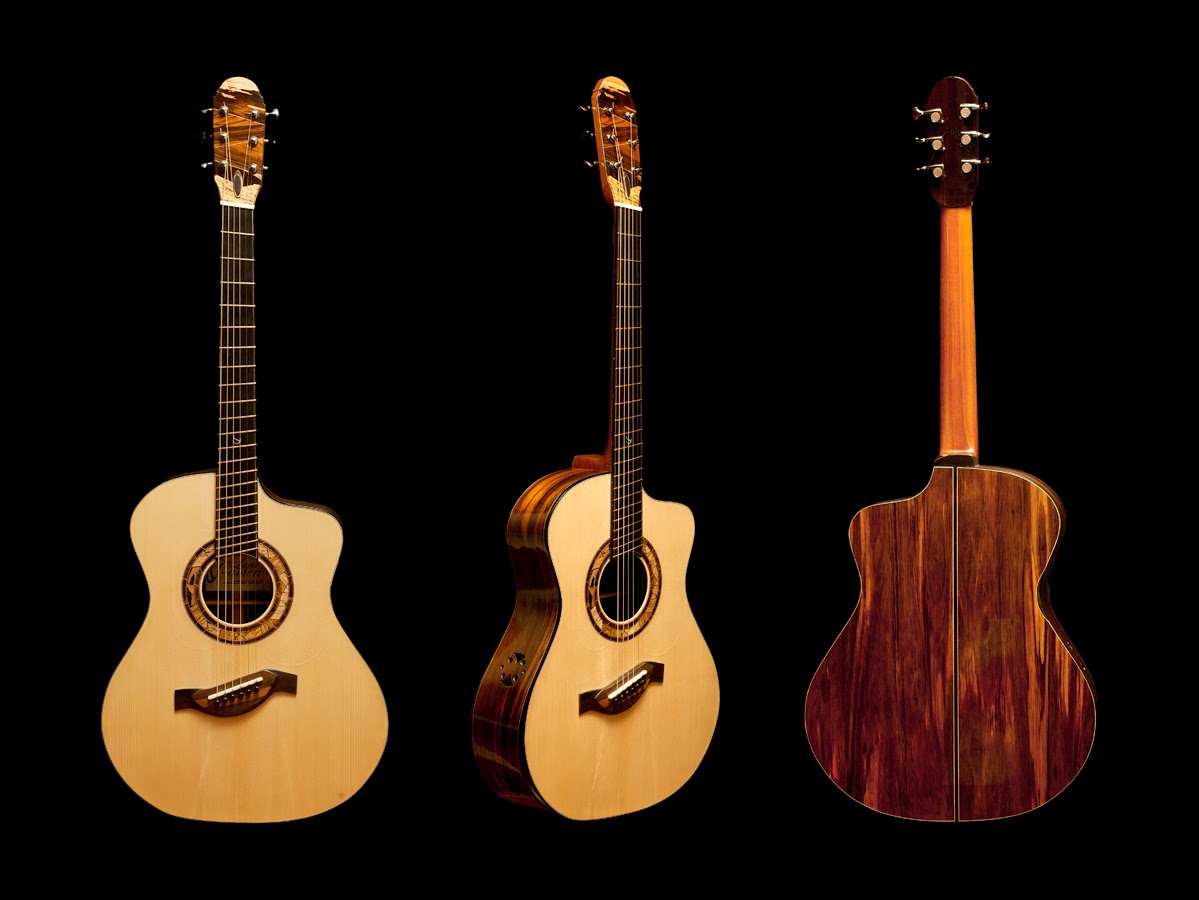
Last month, we went to Fuerteventura and visited Luca’s workshop. After Tamara had finished photographing two more of Luca’s masterpieces, I had a go on them.

The first of them, Grand Concert Cutaway, has a look and feel of the Grand Concert Multiscale but is even more beautiful.

(a)

As you can see, the cutaway is not very deep. It does not give you completely unimpeded access to the higher frets. But ask yourself, do you really need it? Instead, you get this amazing body shape and the sound to die for.

(b)(c)

Model specification: LC Grand Concert Cutaway

  • Woods: Val di Fiemme Spruce, Makassar Ebony back and sides, Ebony bindings, Brazilian Rosewood Fingerboard
  • Triple ring rosette (b) and Headplate (c): Brazilian Rosewood & Makassar Ebony
  • Bone saddle and nut. Back horn bridge pins
  • Tuners: Gotoh 510 mini 1.18 ratio
  • Nut: 45 mm
  • Bridge strings spacing: 58 mm
  • Multiscale: 25″—26″
  • Waist: 25 cm
  • Upper bout: 29 cm
  • Lower bout: 39.5 cm
  • Body length: 49 cm
  • Overall length: 102 cm

After playing a multiscale, a “normal” fretboard, at least for a little while, feels a bit weird.

La Classica (d) looks more like a flamenco instrument than a concert classical. However, it sounds very different from flamenco guitar. If anything, its sound reminded me that of one cedar-top guitar I heard in Peter Barton’s workshop at the Leeds College of Music back in 1996 (sorry can’t be any more precise!), soft, sweet and long-lasting. Besides, it is a very comfy instrument to play. (As I had mentioned before, the steel string guitar’s neck is too narrow for me.) A pleasure for ear, eye and hands alike.

(d)

Model specification: La Classica

  • Top: Italian Val di Fiemme Spruce
  • Back and Sides: Burmese Rosewood
  • Ebony Fingerboard
  • East Indian Rosewood Bindings
  • Bone nut and saddle
  • Schaller Tuners
  • K&K pickup
  • Nut width: 54 mm nut width
  • Upper bout: 29 cm
  • Waist: 25 cm
  • Lower bout: 37 cm

More photos of acoustic guitar @ Shutterstock.

Saturday, 23 August 2014

Techari Live

by Ojos de Brujo

Real Madrid or Barça? Or, closer home, at least as far as this blog is concerned: Canteca de Macao or Ojos de Brujo? Don’t make me choose, I love both. But while the Barcelonians were the first of the two bands for me to discover some ten years ago, I missed my chance to see them live: OdB was disbanded in 2013.

As the name implies, Techarí Live is the live version of their 2006 studio album. When I first heard Techarí, I found it vastly inferior to its predecessor, Barí. (Imprinting or not, but at the time I thought that all this Cuban brass was unnecessary extravagance!) To fully appreciate the music and musicianship, not to mention the dance, one has to watch the DVD.

A word of warning though: the video quality is not the best. It looks as if it was filmed twenty years earlier and then transferred, rather sloppily, from VHS to DVD. I don’t think it was meant to be like that. The sound on the DVD also could have been better — I mean, both the CD and the DVD are the same concert from 22 December 2006, right? Curiously, the song order on the CD is different from that on the DVD.

The concert features quite a number of “invitados” including Martirio, Gyan Singh and Faada Freddy of Daara J. A magical thing happens: instead of being guest stars, they all become a part of Ojos de Brujo. Oh, and did I mention the dancers? Bailaores? Bailaoras? The best part was kept for the end: Sabor de Gràcia and Patriarcas de la Rumba, a group of elderly “tios” and a “tia” performing Bombón (sadly, this bit is missing from the CD). I wish I had been there.

Tuesday, 19 August 2014

From Fuerte, with things

I hate my smartphone. It has a most annoying habit of doing things on its own, like phoning another person’s mobile and not hanging up, or switching itself on and off. Last Thursday, it locked itself. It couldn’t choose the least appropriate moment to do so.

I was flying from Gran Canaria to Fuerteventura to collect our household stuff which we left behind in a storage room (trastero) when we moved to Finland. The “proper” (British) removal company gave me a quote which we were not prepared to pay. Eventually I found a local man with a van who took the job. He and his partner were travelling by ferry on Thursday morning. I was to meet them in the afternoon, pack and load the van, spend a night in Corralejo and go back home with them next day.

Just before the plane took off, I, like a good boy, had switched the phone off. When we landed, I found the damn thing on and locked. Apparently, it switched itself on and tried, unsuccessfully, to guess the PIN number. Not so smart, eh? Now it was demanding the PUK which I, of course, didn’t know. I was not sure that I kept the original plastic thingy (does it have a technical name?), and even if I did, I had no clue where it could be. Maybe in trastero?

I popped to the Movistar shop to buy a new SIM card. Luckily, all the important numbers were stored in the phone’s memory and not on the locked SIM (although this smartass is also known to lose some of my contacts in the past). So I was saved.

It took us three hours to clear the trastero. There was not that much stuff, however the tiny room was pretty full and there were some steric constraints I completely forgot about. For example, to extract a bookcase (there were four of them), we had to flip it upside down while moving through the door. All our things seemed to survive this year without any damage and even did not collect much dust. To my amazement, I found the plastic card with the PUK number under the foot of the last bookcase.

It was nine o’clock already when we finished our job. I went to the C.C. Campanario because I needed to do some minimal shopping and to get something to eat. Better still, I was in time to see the second half of de lo Flamenco performance!

Next morning, I met Luca who brought me two more boxes (books again!) and the last of my musical instruments which he was hosting for a year. Finally, the van was full. We started from Corralejo at midday. It was a holiday, Asunción de la Virgen. The roads were largely empty, and we had reached Morro Jable much faster than expected. The sky was dusty-grey; it looked like the kalima was coming.

Good bye, Fuerteventura. It feels a bit strange that there are no more material things left that would oblige us to come and get them. But we’ll be back anyway.

More photos of Fuerteventura @ Shutterstock.

Sunday, 10 August 2014

Dralion

by Cirque du Soleil

Almost quarter of a century ago, still in Moscow, we (Tamara, my brother and I) went to see Shlomo Carlebach supported by Jerry Katz and his band. It was a great show. An extra entertainment was provided by an old guy who happened to sit just behind us. Throughout the first part of the concert he was complaining, addressing not only his wife but also his surroundings, about the support band. Evidently the sound was too loud and modern for his liking. My favourite of his comments was: “Что вы им хлопаете? Чем больше мы будем хлопать, тем дольше они будут играть.” (“Why are you applauding them? The more we clap, the longer they will play.”)

Shlomo Carlebach was playing the second half. There was no running commentary, so I turned around to check if the oldster finally left the building. No he didn’t. By the time the show ended, he had recovered his faculty of speech.

“Я не знаю, что там было 30 лет назад, но сейчас это не то...”
(“I don’t know what it was 30 years ago, but now it’s not the same...”)
Now the last thing I want to sound like is that grumpy old-timer. Yet I found myself uttering his very words after watching Dralion. This is the first show of Cirque du Soleil I’ve ever been to. Perhaps I set my expectations too high. If it was, say, Las Palmas Community Circus, I’d probably think it was one hell of the show. But then they wouldn’t be charging €36 for the cheapest seat.

The show was in the brand new Gran Canaria Arena, an impressive venue for watching sports but hardly a substitute for a big top. It could be nice if any of the relevant websites bothered to mention how to get there. We took the line 91 city bus, Teatro—Tamaraceite, to Pintor Felo Monzón, 22 (the corresponding stop on the way back is called Pintor Felo Monzón, 17). Allow about ten minutes to walk to the arena from that stop.

The choreography was good. The costumes were stunning. The clowns were pretty annoying, as per usual. The circus proper was a mixed bag. For example, the juggler was performing kind of breakdance, which I rather liked, but the juggling itself was nothing to write home about, and he managed to drop the balls a few times. Of four gods/goddesses, I found Azala (Air) and Océane (Water) to be completely useless. Gaya (Earth) was the best. The aerial silk act (pictured on all posters of Dralion around the town) was conspicuous by its absence. The three best acts were:

  1. Trampoline, with the acrobats jumping (and running) on and off the wall
  2. Hoop diving (also featuring Gaya’s African dance)
  3. Skipping rope guys
The music was not bad but at times it sounded suspiciously like a soundtrack. Since the band was hidden behind the wall, I can’t tell how much time they were actually playing. As for singing... the show could have been way better without it.

Tuesday, 5 August 2014

Saku Kuld

There are many things I am going to miss, or missing already, about Finland. Finnish beer is not one of them.

At its very best, Finnish beer — any Finnish beer that I tasted, that is — is nondescript. At its usual, it’s best replaced by something else. I don’t know what the secret is.

Now that I am safely back to Canaries, I can offer my totally unsolicited tips for responsible beer drinking in Finland. Here:

  • If you have enough Polish (Czech, German, Dutch etc.) beer in your fridge, stick to it.
  • If you don’t have enough Polish beer, start with Finnish beer and polish it off with Polish, not the other way round: the pain of disappointment will be unbeerable. Save your Asahi and Leffe for the very end. Unless you’ve got something worse, never finish with Finnish.
  • If all you have is Finnish beer, take it olut of the fridge and put it into the freezer for an hour, then take it with you to the well-heated sauna. The contrast of temperatures could make it just about drinkable, or, if you happen to “supercool” it, spoonable.
  • If the only bear you have is Karhu, it’s time to leave your lair and do some basic shopping. That probably means there is no proper food left in the fridge either.

Saying that, I’ve managed to discover an excellent beer in Finland. It comes from Estonia’s Saku Brewery. It is slightly cloudy and has a great fresh taste thanks to, I just learned, Nordic oat malt. In the Alko shop, a bottle of Saku Kuld costs €2.89 (€5.58 per litre is cheap in Finland). Enjoy!

More photos of beer @ Shutterstock.